Get Adobe Flash player

The potential repercussions of the fourth Gulf War on Iraq

Monetary policy and economic policy in Iraq: challenges and solutions.

The Islamic approach to addressing contemporary societal crisesAmerican-Israeli war on IranMonetary policy and economic policy in Iraq: challenges and solutions.Professor Dr. Abdul Karim Al-Dabbagh, Professor Ali Hussein Mahfouz, and a group of researchers and academicsThe potential repercussions of the fourth Gulf War on IraqHussein Ali Mahfouz... Sheikh of Baghdad and Memory of HistoryPersonal development and leadership in energyApplied Ethics .. Environment and PollutionThe water and energy crisis between misuse and religious legitimacyThe National Investment Authority's vision for strategic projectsThe Iraqi character between the atmosphere of cafes, palaces and minaretsGovernance and decision-making processAssistant Professor Dr. Qahtan Nimah Hassan Ali Al-KhafajiBuilding confidence and strengthening national identityDrug abuse and its effects on society throughout history and the role of universities in diagnosing the phenomenon and ways to prevent itFrom Jundisapur School to the House of Wisdom, Syriac translators and scholars Artisans in the Islamic Golden Age civilization and the Renaissance of EuropeThe first meeting with officials of the House of Wisdom book exhibitions in Iraqi universitiesFrom the Jundishapur School to the House of Wisdom: Syriac Translators and Scholars Makers of the Islamic Golden Age and the European RenaissanceIslamic thought between justificatory realism and dreamy idealismMigration, Asylum and Humanitarian Challenges between International Responsibility and National ObligationsTogether to end violence against womenA 16-day campaign to combat violence against women and girlsHouse of Wisdom participates in the celebration of the Day of Elimination of Violence against WomenIslamic trends in contemporary Iraqi thoughtCelebrating the scientific achievement of history professorsThe impact of religions on the prevalence of the concept of societal peacePeople of the Book in the Holy Qur’an, selected examplesEconomic diplomacy...and its political and economic effectsThe future of the relationship between the federal government and the Kurdistan Regional Government.Pioneers of contemporary Iraqi philosophical thought (philosophical readingsEmbodying intellectual security in Islamic law and its impact on societyEffective and sustainable water management using different irrigation systemsPhilosophical relations between Iran and Iraq .... Past experiences and future prospects The feminist literary movement in Iraq during a hundred years between gains and challengesAnnual Baghdad DayThe book is a window of thought towards knowledge and creativityHouse of Wisdom opens permanent book fairs in Iraqi universitiesCelebrating World Translation DayRisk management according to international standards (ISO31000:2018)Advisory Council of the Department of Islamic StudiesLegal culture is an absolute necessity...to know your money and what you oweCelebration of International Rural Women's DayEncouraging and developing investment in the industrial sector in IraqInternational policies and strategies in the Middle East After the recent events in GazaThe presence of philosophy and religion among Muslim philosophers (selected models)Iraqi-Japanese perspectives on history, culture, and archaeologyThe sacred and the otherThe role of school activities in building the educational processThe national economy from the perspective of Islamic bankingEarly detection of breast cancer

receipt of scientific research

Search

Monthly activity schedule
Statistics

Current Visitors No : 26
Today Visitors No : 1388
Yesterday Visitors No : 1665
Total Visitors No : 1879693

Complaints and suggestions

From Photo Gallery
E-IRAQ
Newsletter

Name  :
Email :
 

News Details

The Deviation of Financial Enhancement in Iraq’s Public Budget: The White Paper as a Solution

20-12-2020
The Deviation of Financial Enhancement in Iraq’s Public Budget: The White Paper as a Solution


The Deviation of ReinforcementFinancial in Iraq's Public Budget: The White Paper as a Solution


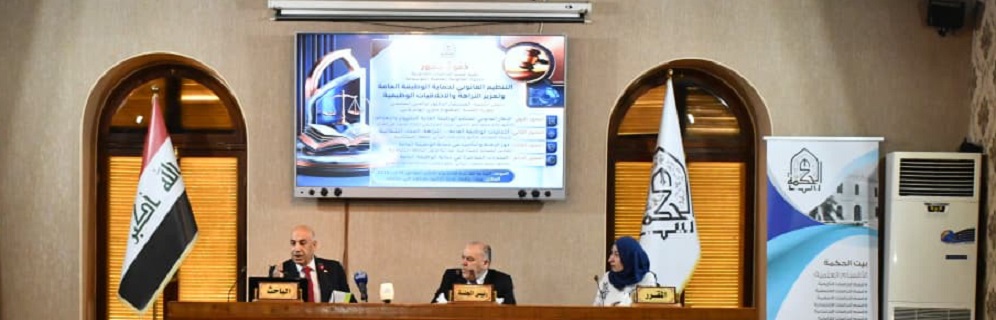
House of Wisdom / Department of Economic Studies held a symposium entitled: (The Deviation of Financial Enhancement in the Public Budget of Iraq: The White Paper as a Solution), by Dr. Mazhar Muhammad Saleh / Adviser to the Prime Minister, at exactly 8:30 pm on Sunday 20/12/2020 at Zoom electronic platform.
Session Chair: Prof. Falah Hassan Thuwaini - Consultant, Department of Economic Studies
Session Rapporteur: Eng. M. Hussein Ghazi Rashid - Rapporteur of the Department of Economic Studies
  Dr. Falah Thuwaini opened the symposium by taking a look at an illustrative chart that shows the most important goals that the White Paper seeks to achieve. It represents a comprehensive roadmap aimed at reforming the Iraqi economy and addressing the serious challenges facing it, which have accumulated over the past years due to wrong policies, mismanagement, corruption and absence of planning in addition Almost total dependence on oil as the main source of state revenue. Among these goals are redefining the role of the state and society - making radical improvements to the state’s management of the financial system to achieve stability in it - creating the appropriate environment to create a vibrant economy by improving the basic legal and administrative infrastructure - structuring the financial and banking system - addressing the factors that led to low labor productivity - Protecting vulnerable groups during and after implementing reforms.
  After that, Dr. Mazhar began his speech by asking the following question: Has a financial deviation occurred from the year 2003 to now in Iraq, as the government's gross domestic product reaches 65% and public expenditures amount to approximately 45% of the gross domestic product, meaning that the government has a heavy weight in the economy And it has been shown that financial reinforcement represents a financial policy that aims to achieve two goals:
Reducing the budget deficit so that it does not exceed 3% of GDP, which is the permissible limit according to international standards.
Reducing the accumulation of indebtedness so that it does not exceed the threshold of 60% of GDP, in order to achieve financial space that makes it possible to borrow when needed.

Share |

More News