.jpg)
.jpg)
receipt of scientific research

Search
Monthly activity schedule
Statistics
Current Visitors No : 43
Today Visitors No : 1312
Yesterday Visitors No : 1992
Total Visitors No : 1968521
Today Visitors No : 1312
Yesterday Visitors No : 1992
Total Visitors No : 1968521
Complaints and suggestions

From Photo Gallery
E-IRAQ
Newsletter
News Details
The centenary of the birth of the Palestinian historian Hanna Batatu (Arabic - English)
23-04-2026
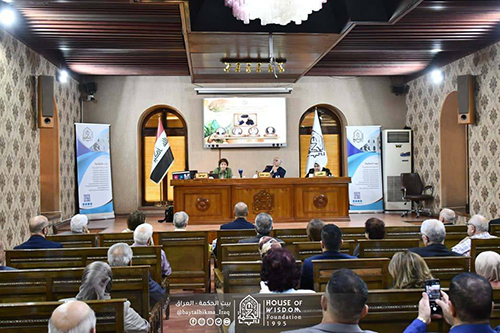
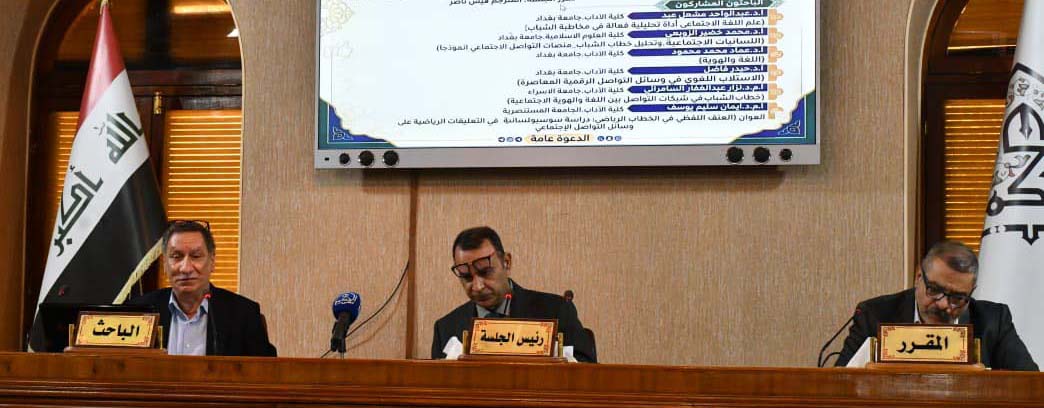
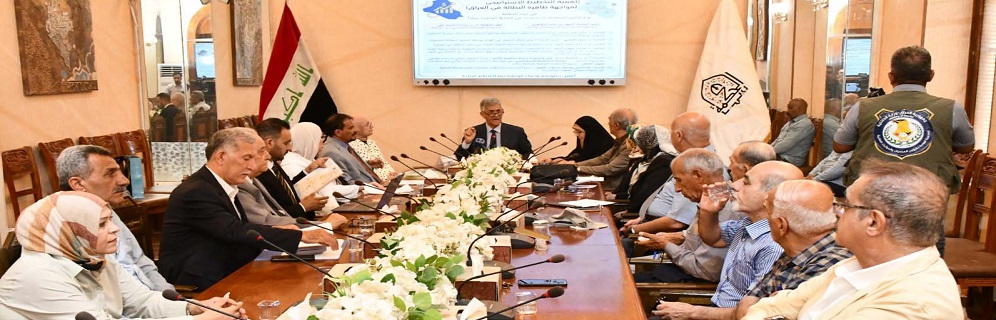
On the occasion of the 100th anniversary of the birth of the Palestinian historian Hanna Batatu, Bayt Al-Hikma – Department of Historical Studies, held a scientific seminar on Thursday, April 23, 2026, titled “Hanna Batatu… A Palestinian Historian Who Documented the Modern History of Iraq”, at the Dr. Mahmoud Ali Al-Daoud Hall. The session was chaired by Professor Dr. Falah Hassan Al-Asadi and moderated by Dr. Nowar Ali Ahmed from Bayt Al-Hikma.
The seminar revisited the legacy of a prominent historian who sought to study and understand modern Iraqi society, analyze its social structure, and interpret the political and cultural transformations of contemporary Iraq. The focus on Hanna Batatu aimed to highlight leading scholars who devoted their work to documenting Iraq’s history, serving as exemplary models for rigorous research in the service of the country.
A distinguished group of academics from within Iraq and abroad participated in the seminar. Among them were Professor Dr. Luhay Abdul Hussein from the College of Arts at the University of Baghdad, Professor Dr. Haider Saeed from the Arab Center for Research and Policy Studies in Doha, and Dr. Nahar Mohammed Nouri from the College of Arts at Al-Mustansiriyah University. They presented research papers examining Batatu’s engagement with Iraqi history and his documentation of social, political, and economic transformations from the late Ottoman period to the early 1970s.
During this period, Iraq witnessed significant political movements and upheavals, including the outbreak of the Iraqi Revolt of 1920, the establishment of the Iraqi state, British treaties, and later the 1958 Iraqi Revolution. These developments profoundly shaped the country’s social and economic relations. The importance of Batatu’s work lies in his meticulous documentation of Iraq during this critical historical phase.
The researchers also discussed the sources Batatu relied upon in his writings, his relationships with political figures of the time, and his personal characteristics that were reflected in his scholarly works. They explored his reasons for choosing Iraq as a field of study, his foresight regarding sectarian balances and their disruption after 1958, as well as the challenges he faced in conducting his research on Iraq.
In conclusion, the Chairman of the Board of Trustees of Bayt Al-Hikma, Dr. Qahtan Nehmeh Hassan Al-Khafaji, presented certificates of appreciation to the participating researchers, commending their valuable contributions to the seminar, which was attended by a number of professors, researchers, and individuals interested in historical and cultural affairs.
More News
The vision and mission

Strategy Plan

FREE books

Film
Change the value of the Iraqi currency .. Benefits and costs Seminar held by the Department of Economic Studies
Clock
Visitor Map
mop
Energy subsidies and emissions reduction