|
The role of the translator in crafting an awareness message about the dangers of drugs across diverse languages ​​and cultures
2026-04-09
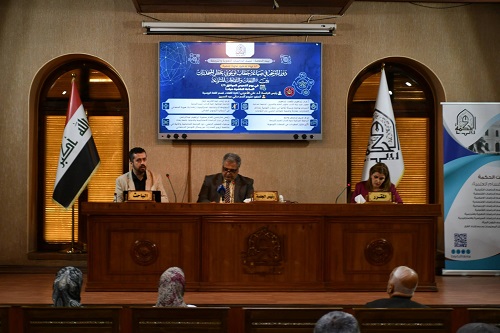
The Role of the Translator in Formulating Awareness Discourse on the Dangers of Drugs Across Diverse Languages and Cultures
On Thursday, April 9, 2026, Bayt al-Hikma - Department of Linguistic and Translation Studies, held a scientific symposium titled "The Role of the Translator in Formulating Awareness Discourse on the Dangers of Drugs Across Diverse Languages and Cultures." The event took place at the Dr. Mahmoud Ali al-Dawood Hall, in the presence of the Chairman of the Board of Trustees of Bayt al-Hikma, Dr. Qahtan Ni'ma Hassan al-Khafaji.
The symposium highlighted the importance of translation as an effective tool for conveying awareness messages regarding drug risks across different cultures, focusing on the translator's role in building an influential discourse capable of reaching diverse segments of society. It also discussed mechanisms for utilizing language to counter the spread of drugs, particularly through digital space and social media.
The session was chaired by Professor Dr. Ali al-Araji from the College of Languages - Russian Language Department, and Ms. Sally Abdul Hussein from the Department of Linguistic and Translation Studies at Bayt al-Hikma served as the session's rapporteur .
A group of specialized researchers participated in the symposium by presenting several research papers. Assistant Professor Dr. Ibrahim Talat Ibrahim, Assistant Dean for Student Affairs and Registration at the College of Arts, Al-Iraqia University, presented a paper titled "The Translator as a Cultural Mediator in Drug Awareness Campaigns: A Functional Approach to Cross-Cultural Health Communication," in which he discussed the translator's role as a cultural mediator who helps convey awareness messages while respecting linguistic and cultural differences to enhance impact among target audiences.
Dr. Fawzia Moussa Ghanem presented a research paper titled "The Dramatization of International Works and Its Role in Education Against Addiction," reviewing how adapting international literary and artistic texts for the stage can promote awareness using methods that resonate with the public, emphasizing the importance of theater as an influential educational medium.
Assistant Lecturer Zainab Abdul Karim Dinar from the College of Arts, Al-Iraqia University, participated with a paper titled "Social Resistance: Strategies for Reconstructing the Recovering Individual's Identity in Iraqi Awareness Discourse," demonstrating the translator's key role as an agent of social change through the analysis of localization strategies and identity reconstruction.
Assistant Lecturer Sura Jurgis Wadea from the College of Arts, Al-Iraqia University, presented a paper titled "The Impact of Vocabulary Choice in Awareness Campaigns," addressing the importance of precise terminology in formulating messages and its direct role in influencing the recipient's response to reducing drug risks.
Finally, researcher Samira Ibrahim Abdul Rahman, Head of the Translation Unit at the Center for Strategic and International Studies, University of Baghdad, submitted a paper titled "The Semiotics of Digital Encryption: The Role of Specialized and Machine Translation in Combating Drug Promotion via Social Media," which was delivered on her behalf by Assistant Lecturer Rawaa Mazhar Abbas. The paper reviewed emojis as a vital part of digital communication used as a coded language for illicit activities, stressing that decoding these ciphers is essential for protecting society.
The symposium was attended by a group of professors, academics, and specialized researchers who enriched the event with valuable interventions, comments, and questions. |