|
Climate change and weather in Iraq 2026-04-23
Climate Change and Weather in Iraq
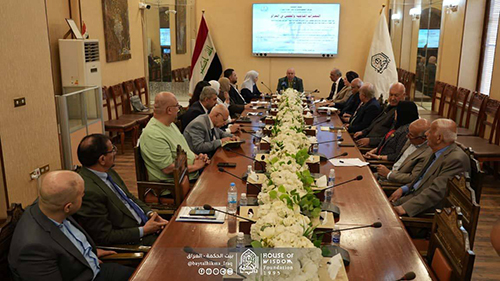
Bayt Al Hikma– Information Center and Decision Support, held its scientific seminar titled “Climate Change and Weather in Iraq” on Thursday, April 23, 2026, at the Hall of Mirrors. The event was attended by the Chairman of the Board of Trustees, Dr. Qahtan Nehmeh Hassan Al-Khafaji, along with a distinguished group of academics, researchers, and specialists in the fields of environment, climate, and water resources.
The seminar shed light on analyzing the reality of climate change in Iraq and its escalating impacts, discussing various weather phenomena, as well as exploring scientific solutions and modern technologies that contribute to supporting decision-makers with effective scientific outputs for sustainable resource management.
The session was chaired by Mr. Jawad Nayef Hadhood Al-Khikan—Head of the Energy, Water, and Environment Department at Al-Nahrain Center for Strategic Studies—and moderated by Ms. Sundus Abdulrasool Majeed Sadiq from the College of Arts at Al-Mustansiriyah University.
A number of researchers participated in the seminar, presenting scientific papers that addressed various dimensions of climate change. Professor Dr. Amani Ibrahim Mohammed from the College of Remote Sensing and Geophysics at Al-Karkh University for Science presented a paper titled “Reducing Plastic: An Individual and Societal Responsibility.” She discussed plastic pollution and its negative impact on the environment and climate, emphasizing that mitigation requires cooperation between individuals and government institutions. She also stressed the importance of raising public awareness and adopting environmentally friendly alternatives.
Dr. Mujib Razuqi Fareeh from Al-Mustansiriyah Center for Arab and International Studies presented a study titled “Spatial and Temporal Changes of Water Bodies in Iraq: The Impact of March 2026 Rainfall and Its Role in Enhancing Water Storage Using Remote Sensing Techniques.” He examined the effects of the rainfall wave witnessed in Iraq during March 2026 using remote sensing and satellite data. The results showed a direct relationship between rainfall intensity and the increase in water bodies, with northern regions and marshlands recording the highest response rates, contributing to a temporary boost in water storage. He highlighted the importance of employing modern technologies in monitoring water resources and supporting future planning.
The seminar concluded with a paper by researcher Marwa Muzhir Hassan from the Iraqi Meteorological Organization and Seismology, titled “Mechanisms of Global Climate Change Impact on Extreme Weather Dynamics.” She explored the relationship between global warming and the increasing intensity and frequency of extreme weather events, explaining that rising temperatures disrupt the thermal balance of the atmosphere and affect jet streams and hydrological cycles. She also pointed out that climate change acts as a risk multiplier, leading to more intense heatwaves, heavier rainfall, and longer drought periods, stressing the need to shift from mitigation to adaptation strategies.
In his remarks, Dr. Qahtan Nehmeh Hassan Al-Khafaji emphasized that climate change in Iraq represents a strategic challenge that necessitates a scientific approach to resource management. He highlighted the importance of institutional cooperation and public awareness to enhance resilience and adaptability to extreme weather phenomena.
The seminar was attended by a number of professors, academics, and specialized researchers who enriched the discussion with their insights, comments, and questions.
.jpg) |
| Prepare the Printer Back to Detail Page |